
Welcome
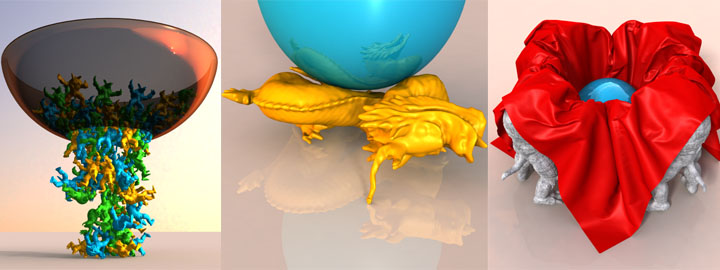
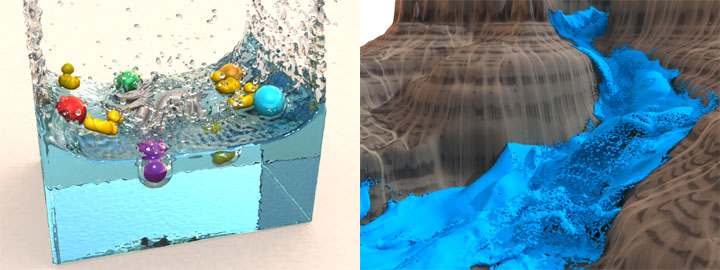
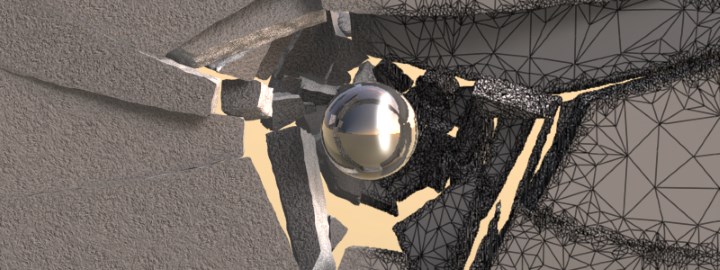

The research of the Computer Animation Group focuses on physically-based simulation of rigid body systems, deformable solids, and fluids, collision handling, cutting, fracturing, and real-time simulation methods. The main application areas include virtual prototyping, simulation in engineering, medical simulation, computer games and special effects in movies.
News
| • |
Best Paper Award Our paper "Consistent SPH Rigid-Fluid Coupling" got the best paper award at the Eurographics Vision, Modeling, and Visualization 2023. |
Sept. 29, 2023 |
| • |
Implicit Density Projection now available on GitHub! The code for our paper "Implicit Density Projection for Volume Conserving Liquids" has been implemented in the open source project Mantaflow and is now available on GitHub. Check here for the most recent version. |
July 27, 2022 |
| • |
Best Paper Award Our paper "Fast Corotated Elastic SPH Solids with Implicit Zero-Energy Mode Control" got the best paper award at the ACM SIGGRAPH / EUROGRAPHICS Symposium on Computer Animation 2021. |
Sept. 10, 2021 |
| • |
Best Paper Award Our paper "Volume Maps: An Implicit Boundary Representation for SPH" got the best paper award at the ACM SIGGRAPH Motion, Interaction and Games. |
Nov. 15, 2019 |
| • |
Best Paper Award Our paper "A Micropolar Material Model for Turbulent SPH Fluids" got the best paper award at the ACM SIGGRAPH / EUROGRAPHICS Symposium on Computer Animation. |
Aug. 15, 2017 |
| • |
SPlisHSPlasH now available on Github! SPlisHSPlasH is an open-source library for the physically-based simulation of fluids. The simulation in this library is based on the Smoothed Particle Hydrodynamics (SPH) method which is a popular meshless Lagrangian approach to simulate complex fluid effects. Check it out here! |
Nov. 17, 2016 |
Recent Publications
 Spatiotemporal FLIP for Fast Free-Surface and Two-Phase Simulation With Very Large Time Steps ACM Transactions on Graphics (SIGGRAPH) - Honorable Mention We present ST-FLIP, a spatiotemporal extension of the Fluid-Implicit Particle (FLIP) method for incompressible free-surface and two-phase liquid simulation. ST-FLIP enables time steps up to an order of magnitude larger than those typically used in CFL-constrained solvers, while preserving detailed flow structures and visual fidelity. It addresses a common failure mode of large time steps in hybrid particle–grid liquid solvers: temporal undersampling of particle motion produces aliasing-driven free-surface artifacts after projection. Our key idea is to interpret particles as samples in four-dimensional space-time: in addition to standard spatial jittering, we randomize particle positions along the time axis as well and perform particle-to-grid deposition using a separable 4D kernel. This yields a Monte Carlo estimator of perstep time-slab-integrated particle quantities. Although particles are treated as samples in 4D space-time, our approach works as a lightweight plugin by collapsing to slab-integrated 3D grid fields for projection. Building on recent particle-based phase-field work, we reuse the particle-to-grid weight accumulators as a conceptual space–time phase field, providing variable-coefficient projection weights and eliminating the need for per-step surface reconstruction. The method can be easily integrated into existing FLIP/PIC or APIC solvers with negligible additional computational cost per time step. The effectiveness of our approach is demonstrated through a series of comparisons with state-of-the-art solvers, yielding several-fold speedups for multi-billion-particle simulations at high effective 3D resolutions on a single workstation. 
|
 Pitfalls of Projection: A study of Newton-type solvers for incremental potentials ACM Transactions on Graphics (TOG) Nonlinear systems arising from time integrators like Backward Euler can sometimes be reformulated as optimization problems, known as incremental potentials. We show through a comprehensive experimental analysis that the widely used Projected Newton method, which relies on unconditional semidefinite projection of Hessian contributions, typically exhibits a reduced convergence rate compared to classical Newton’s method. We demonstrate how factors like resolution, element order, projection method, material model and boundary handling impact convergence of Projected Newton and Newton. Drawing on these findings, we propose the hybrid method Project-on-Demand Newton, which projects only conditionally, and show that it enjoys both the robustness of Projected Newton and convergence rate of Newton. We additionally introduce Kinetic Newton, a regularization-based method that takes advantage of the structure of incremental potentials and avoids projection altogether. We compare the four solvers on hyperelasticity and contact problems. We also present a nuanced discussion of convergence criteria, and show that a criterion based on the balance of acceleration avoids problems associated with existing residual norm criteria and is easier to interpret. We finally address a fundamental limitation of the backtracking line search that occasionally blocks convergence, especially for stiff problems. To overcome this issue, we propose a novel robust line search correction that does not require additional parameters.
|
 Simulation Methods for Multiphysics Phenomena in Visual Computing Eurographics Tutorial Physics simulation is a cornerstone of many computer graphics applications, ranging from video games and virtual reality to visual effects and computational design. The number of techniques for physically-based modeling and animation has thus skyrocketed over the past few decades, facilitating the simulation of a wide variety of materials and physical phenomena. These course notes provide an in-depth introduction to multiphysics simulation methods for computer graphics, covering the mathematical foundations, key algorithms, and practical considerations behind the most widely used approaches. We focus on methods developed by the computer graphics community for simulating various physical phenomena and materials -- including rigid and deformable bodies, fluids, and granular materials -- as well as the interactions between them. For each method, we present the underlying mathematical framework with detailed derivations and discuss how different materials and coupling strategies fit into the formulation. A selection of software frameworks that offer out-of-the-box multiphysics modeling capabilities is also presented. Finally, we touch on emerging trends in physics-based animation, including machine learning-based methods which have become increasingly popular in recent years.
|
