
Profile
|
Timna Böttcher, M.Sc. |
Publications
Implicit Incompressible Porous Flow using SPH

We present a novel implicit porous flow solver using SPH, which maintains fluid incompressibility and is able to model a wide range of scenarios, driven by strongly coupled solid-fluid interaction forces. Many previous SPH porous flow methods reduce particle volumes as they transition across the solid-fluid interface, resulting in significant stability issues. We instead allow fluid and solid to overlap by deriving a new density estimation. This further allows us to extend SPH pressure solvers to take local porosity into account and results in strict enforcement of incompressibility. As a result, we can simulate porous flow using physically consistent pressure forces between fluid and solid. In contrast to previous SPH porous flow methods, which use explicit forces for internal fluid flow, we employ implicit non-pressure forces. These we solve as a linear system and strongly couple with fluid viscosity and solid elasticity. We capture the most common effects observed in porous flow, namely drag, buoyancy and capillary action due to adhesion. To achieve elastic behavior change based on local fluid saturation, such as bloating or softening, we propose an extension to the elasticity model. We demonstrate the efficacy of our model with various simulations that showcase the different aspects of porous flow behavior. To summarize, our system of strongly coupled non-pressure forces and enforced incompressibility across overlapping phases allows us to naturally model and stably simulate complex porous interactions.
» Show BibTeX
@article{BWJB25,
title = {Implicit {{Incompressible Porous Flow}} Using {{SPH}}},
author = {B{\"o}ttcher, Timna and Westhofen, Lukas and Jeske, Stefan Rhys and Bender, Jan},
year = 2025,
month = dec,
journal = {ACM Transactions on Graphics},
volume = {44},
number = {6},
doi = {10.1145/3763325}
}
Weighted Laplacian Smoothing for Surface Reconstruction of Particle-based Fluids
Vision, Modeling and Visualization
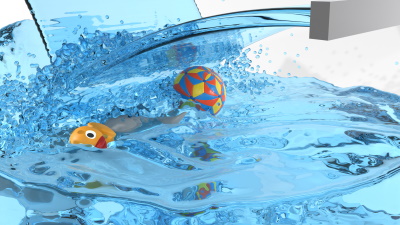
In physically-based animation, producing detailed and realistic surface reconstructions for rendering is an important part of a simulation pipeline for particle-based fluids. In this paper we propose a post-processing approach to obtain smooth surfaces from "blobby" marching cubes triangulations without visual volume loss or shrinkage of drops and splashes. In contrast to other state-of-the-art methods that often require changes to the entire reconstruction pipeline our approach is easy to implement and less computationally expensive.
The main component is Laplacian mesh smoothing with our proposed feature weights that dampen the smoothing in regions of the mesh with splashes and isolated particles without reducing effectiveness in regions that are supposed to be flat. In addition, we suggest a specialized decimation procedure to avoid artifacts due to low-quality triangle configurations generated by marching cubes and a normal smoothing pass to further increase quality when visualizing the mesh with physically-based rendering. For improved computational efficiency of the method, we outline the option of integrating computation of our weights into an existing reconstruction pipeline as most involved quantities are already known during reconstruction. Finally, we evaluate our post-processing implementation on high-resolution smoothed particle hydrodynamics (SPH) simulations.
» Show BibTeX
@inproceedings {LBJB23,
booktitle = {Vision, Modeling, and Visualization},
title = {{Weighted Laplacian Smoothing for Surface Reconstruction of Particle-based Fluids}},
author = {Fabian L\"{o}schner and Timna B\"{o}ttcher and Stefan Rhys Jeske and Jan Bender},
year = {2023},
publisher = {The Eurographics Association},
ISBN = {978-3-03868-232-5},
DOI = {10.2312/vmv.20231245}
}
